Codec – Compressing Audio and Video
"Codec" is a portmanteau generated from the words "coder" and "decoder".
A codec is generally used to compress files, i.e. to make them smaller than they were originally. Size plays an important role in the Internet age, e.g. for streaming data so that users without a fast DSL connection are also able to download content quickly.

Codecs may be roughly differentiated into loss-free and loss-prone formats. Loss-free compression means that the reduction of the data quantity does not directly affect the content in perceivable manner. Loss-prone compression has a noticble qualitative effect on the content.This reduction does not necessarily immediately result in a loss in quality; in the case of MP3, the changes occur outside of the range of human hearing. There are numerous codecs, and only the most conventional will be mentioned here. MP3 is a codec developed by the Fraunhofer Institut in Germany for audio compression. MP3 uses a form of acoustics that only saves those signals that belong to the spectrum of sounds human beings are capable of hearing. This enables a level of audio compression, which only slightly diminishes audio quality and simultaneously requires very little storage space. Another loss-prone compression process is "advanced audio coding“ (AAC). This codec, also developed by Fraunhofer, is based on an improved compression and loses less audio quality during compression.
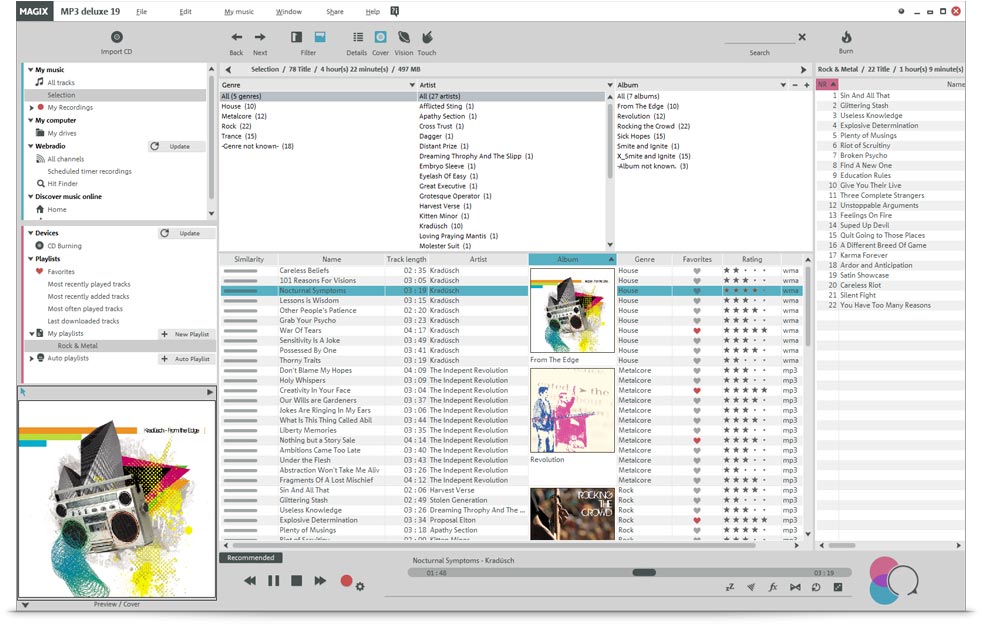
The Codec and MP3 deluxe
MAGIX MP3 deluxe excels at managing music and converting all common audio file formats such as WAV, OGG into MP3s and other formats. Its fast MP3 converter converts music in high quality for perfect sound in every situation.